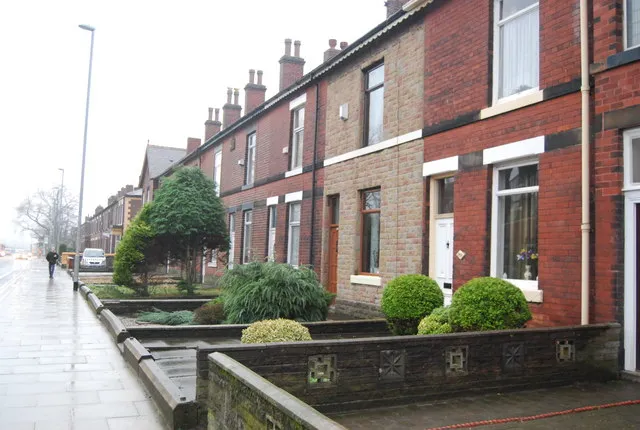
Old Bones, New Life: Sourcing Reclaimed Stone and Timber Around Calderdale
Photo: Eric Jones , CC BY-SA 2.0, via Wikimedia Commons
Reclaimed materials are not a novelty in Halifax; they are part of the town's DNA. The same millstone grit that built the Piece Hall and the terraces up the hills has been reused for centuries, and plenty of local homes already contain stone, timber and ironwork that has had at least one previous life. If you are renovating a period property, or just trying to avoid the shiny uniformity of new-build suppliers, the salvage yards around Calderdale are worth getting to know.
Why old material suits Calderdale homes
Local stone is millstone grit, and it weathers in a particular way: hard, gritty, often soot-darkened, with a surface that new stone takes decades to imitate. Old timber has usually done its shrinking and twisting already, which is why reclaimed oak and pine can be more stable than fresh green wood. Reclaimed ironwork, from gutters to hinges, tends to be heavier and better made than modern equivalents. Using salvaged material also keeps useful things out of skips, which matters when so much of the local built heritage has already been lost.
The catch is that reclaimed material demands more thought. You cannot simply order a pallet of 'old stone' and expect it to match. You need to measure, compare, ask questions and accept that the yard is not a showroom.
The yard circuit around Halifax
Start with the larger architectural salvage yards on the edge of Brighouse and Sowerby Bridge. Places like Riverside Reclamation and Calder Architectural Salvage tend to carry roof slates, bricks, flags, lintels and chunks of ironwork, and they are used to homeowners turning up with a boot full of samples. Further up the valley, Valley Stone & Timber at Mytholmroyd is the sort of yard where you need to wear old clothes and allow an hour to rummage. In Halifax itself, Northgate Reclamation is handy for smaller pieces: door furniture, hinges, hooks, chimney pots and the odd stone sink.
Do not expect tidy aisles. The best yards are organised chaos, and the person behind the desk usually knows more than the website does. Take photographs of the area you are trying to match, plus a tape measure and a sample of your existing stone or timber if you can safely remove one. Ask where the material came from, whether it has been reclaimed from a listed building, and whether it has been cleaned or treated.
Stone: match the bed, not just the shade
With stone, colour is only half the story. Millstone grit varies in texture and in the way it splits, and a lintel from one quarry will not necessarily sit happily next to a wall built from another. Look at the face of the stone, the arrises and the thickness. For a garden wall or a patch repair, a close match is usually good enough. For a front elevation, take more care. New stone can be dressed to match, but it will look new for years, so a reclaimed piece with some weathering is often the better answer.
Check for cracks, delamination and old cement pointing. Cement mortar is the enemy of old stone because it traps moisture and forces it out through the face of the stone, which leads to spalling. If you are repointing, use a lime-based mortar that lets the wall breathe. If the stone is going into a listed building or a conservation area, check with Calderdale Council before you start; consent rules are not a formality.
Timber: check for rot, worm and hidden nails
Reclaimed timber is brilliant for beams, mantels, shelves and floorboards, but it is not automatically sound. Look for soft patches, frass, active worm holes and splits that run through the grain. Old oak can be as hard as iron, but old pine can be riddled. Run your hand over the surface and tap it with a knuckle; a dull thud may mean rot inside. Check for nails, screws and grit before you put a saw or a plane anywhere near it.
If you are using reclaimed timber structurally, get an engineer involved. A beautiful old beam is no good if it cannot carry the load. For decorative pieces, a good clean and a coat of wax or oil is usually enough. Avoid sandblasting old oak; it rips out the soft grain and leaves a surface that looks nothing like the original. A stiff brush and a bit of patience are kinder.
Ironwork and the small stuff
The smaller salvage finds are often the most useful. Cast-iron gutters, hopper heads, fireplaces, door hinges, window catches and boot scrapers turn up regularly, and they can save a period home from a rash of modern substitutes. Check cast iron for cracks and rust that has gone right through. Surface rust is normal and can be wire-brushed and painted, but deep corrosion is not worth the trouble. Keep original patina where you can; stripping every piece back to bare metal can make an old house look oddly new.
Legal and practical checks
Reclaimed material still has to meet building regulations. Stone and timber used structurally may need to be assessed, and insulation, damp proofing and ventilation all matter when you are changing how a wall or floor performs. Do not remove material from a listed building or a site of special interest without permission. If you are buying from a yard, ask for a receipt that describes what you have bought. And buy a little more than you need, because matching a broken flag or a damaged board later is much harder than storing a spare.
Using reclaimed pieces without making a museum
A few well-chosen pieces go a long way. Reclaimed flags in a hall, a salvaged beam as a mantel, a stone sink in a utility room, old iron brackets under a shelf: these are the sorts of details that settle a house rather than shout about it. At Conway's of Halifax, we see reclaimed materials doing quiet work in all sorts of local homes, from terraces to converted mills. The trick is to use them where they solve a problem, not just where they make a statement. Get the structure right, keep the details honest, and let the old bones do the talking.